Showing posts with label equipment. Show all posts

Tuesday, 24 August 2010

UK orders more Desert Hawks


The MoD has today placed a $5.1million order with Lockheed Martin for additional Desert Hawk III UAVs. Having already supplied around 100 systems to UK forces as part of a UOR for Afghanistan in 2007, this additional tranche is scheduled for delivery by the end of the year.

Although operating Desert Hawk looks similar to playing Call of Duty, this is a mean piece of kit which, according to Staff Sergeant Dan Gardner from 47 Regiment Royal Artillery,"has become indispensable to troops on the ground in Afghanistan".

Used in a variety of roles, including reconnaissance and surveillance of troops and patrols, Desert Hawk provides situational awareness to commanders of troops in contact with the enemy. One particularly valuable use to which it has been put has been spotting the Taliban as they lay IEDs. Desert Hawk is one of several systems which make up ISTAR, the tri-service intelligence, surveillance, target acquisition and reconnaissance infrastructure.

As well as providing improved surveillance capability and all-weather operation, the latest variant will also include a 'more refined target position' system olr as the MoD spokesman said: "Desert Hawk's latest enhancements allow it to operate more effectively in difficult conditions and provide our soldiers with greater situational awareness in a very timely manner."

MoD: Upgraded surveillance aircraft arrive in Afghanistan
Lockheed Martin: Desert Hawk III

Monday, 22 March 2010

Scout goes to US company, General Dynamics

The MoD has today confirmes that British arms manufacturer BAE Systems has lost out to the American company General Dynamics in the race to secure the $6billion contract for the next generation of light tank for the British Army.

The initial order will be for around 600 of the so-called Specialist Vehicles with oders for more likely at a later stage.

Although the contract is going to an American company the MoD has gone to great lengths to claim that the vehicles will be assembled in the UK. Yeah, well we've heard that before. General Dynamics will doubtless start repatriating jobs when the going gets tough back home.

This deal is another example of Britain losing expertise, particularly R&D, to foreign companies; once these skills and the manufacturing base are lost, they will never return. Every sell-out to a foreign country digs away at our ability to act independently. We've seen how hostile the current US administration is to the UK when Hilary Clinton joined forces with Argentina saying that the sovereignty of the Falkland Islands is negotiable. With the extra control the US will now have over the Army's tank fleet, they may make negotiation the only option.

I wonder how much the lobbyists and their labour party stooges get for securing a $6billion contract. I image that would have been a very expensive cab.

MoD: New contract for more armoured fighting vehicles
BBC: General Dynamics beats BAE to win UK tank-making deal

The Mail: Government accused of 'cover-up' over 'cash for access' scandal after No 10 refuses to launch investigation

Wednesday, 10 March 2010

LPPV catfight (2): Ocelot or Supacat?


It was at last year's DSE International Exhibition (see Aquilavictrix LPPV: Orcelot v SupaCat) that the mittens came off in the contest between Force Protection's Ocelot and Supacat's SPV400 to win the contract for the Light Protected Patrol Vehicle (LPPV) that will replace the Army's much criticised Snatch Land Rover. The two contenders have been undergoing engineering and operational trials at test facilities at Millbrook and Aldershot and a decision on the winner is expected by August with a military in-service date the following year. Funds will be provided through the Urgent Operational Requirements process.

Back in Spetember 2009 the MoD was saying that they were initially looking to place orders for 400 vehicles. Needless to say, Gordon Brown has now halved that. Continuing his 12 year jihad against the Armed Forces, the prime minister has taken another swipe of his axe to the Army's funding and announced that now only 200 would be ordered.

Funnily enough and with true labour spin, he tried to make his announcement sound as if he was promising 200 extra vehicles rather than what he was really doing which was to provide 200 fewer! The hypocrisy and duplicity of this man is unbelievable!

Brown's announcement comes in the wake of the barrage of criticism that he and his fellow ministers received at the inquiry into the deaths of the four soldiers killed when their poorly protected Snatch Land Rover was hit by an IED. This decision of Brown's to actually halve the number of Snatch vehicles being replaced, is therefore particularly callous and sinister coming as it does at this time.

DefenseNews: 2 Vehicles Vie for U.K. Army LPPV Award

Wednesday, 3 March 2010

Army training at the touch of a screen

LINE Communications, a leading supplier of Technology Based Training, has announced the imminent release of three major mobile learning solutions for the British Army.

The MoD has commissioned LINE to develop three highly innovative learning solutions to be delivered on mobile devices. Two of the projects will be delivered using Apple iTouch. The first covers training on vehicle service schedules and the second delivers restricted content quickly and securely to the target audience. The third project delivers complex procedural training using touchscreen tablets. All of the projects are due for release in early April 2010.

LINE prides itself on working "pragmatically to deliver the MoD’s modernisation and training transformation agenda across Defence to genuinely improve operational capability".

Let's hope LINE's touchscreen solution is significantly better than my new LG-POP which fails to respond however gently or firmly, casually or positively, I touch the screen.

Sunday, 21 February 2010

BAe's Terrier unleashed

Production has started at BAe Systems' plant in Newcastle on the prototype Terrier engineer vehicle. 60 Terriers were ordered for the Army last March in a £300million contract which also secured 650 British jobs.

The Terriers will fulfil a variety of roles for the Army: obstacle and mine clearance, digging-in equipment and troops, route opening and maintenance, and general engineer tasks.

Lessons learnt from production of the Titan, Trojan and Panther, particularly with regards to blast protection, have been built into the design of this latest dog of war.

Reliability has been another key in-built feature of the Terrier. Earlier trials have convinced the MoD that the Terrier will meet the exacting reliability levels prescribed for the vehicle which are over and above those of Armoured Fighting Vehicles currently in service with the Army.

BAe Systems: TERRIER Engineer vehicle passes two key milestones

Thursday, 18 February 2010

Python: the full monty - and the Taliban's gone for a burton


The Army has brought in its latest weapon to counter the Taliban's IEDs. Used yesterday for the first time in Afghanistan, the explosives on the 230-metre long snake-like rocket-propelled device will clear a large area thought to contain mines and improvised explosive devices. Mounted on the back of a Trojan armoured engineer tank, the Python replaces the ageing Giant Viper, which dates back to the Fifties, and has the ability to clear a much longer 'safe lane' than its predecessor.

Staff Sergeant Mark Eastley, from 30 Armoured Engineer Squadron, said: “It takes your breath away. You see the flash, hear the bang and then feel the shock wave.” Or as Lieutenant Colonel Matt Bazeley, commanding officer of 28 Engineer Regiment, put it: "We are clearing this belt of death so that civilians and their families can begin to live without fear of being blown to pieces by a cowardly and dishonourable enemy that is happy to kill indiscriminately."

Python reminds me of those ingenious devices which inventors came up with during WW2 to combat German mines. I think it was in an episode of World at War that we saw film of giant rocket-powered cartwheels careering over beaches and tanks with revolving chains protruding from their fronts flaying the ground ahead for mines. The Germans themselves came up with their own minesweeping machines: the WunderWaffe 4, which rolled out of one of Krupp's factories in 1944, was a 130t vehicle, articulated in the centre, suspended on 12ft diameter steel wheels and designed to clear a wide path through a minefield.

As they say "necessity is the mother of invention" and, as the Taliban get ever more sophisticated in their use of the insidious IED, so too does NATO develop new technologies to counter them.

Forewarned about Operation Moshtarak, the Taliban had planted thousands of IEDs and booby traps ahead of advancing Allied soldiers. Python will help to clear these and make the area safe for British soldiers and for the local Afghan people alike.

The Times: 'Python' is British Army's winning weapon against Afghan roadside bombs

The Mail: Operation Moshtarak: British Army unleashes latest weapon in battle with 'dishonourable enemy'

Monday, 15 February 2010

MoD to end secret research programmes


This is a busy time of the year for companies wishing to get their hands on lucrative defence research funding.

Last week the Centre for Defence Enterprise at Harwell showcased several projects which have already received government funding. Incorporating a range of technologies, these projects aim to ensure that UK forces "will have the battle-winning edge in current and future conflicts".

They include

  • textiles that could be made into uniforms and used to power weapons, radios and charge batteries;
  • unmanned surveillance systems that could stay airborne for upto 3 months;
  • a portable solar-powered battery to increase power at FOBs;
  • turret-based camera to provide wide-angled surveillance images;
  • 3D persistent surveillance systems;
  • I'm getting lost here so visit:-
  • NDS: The Appliance of Science to Benefit Frontline Troops
Next month the MoD will be hosting its annual Defence Research conference and exhibition at the ICC in Birmingham. The main partner in this enterprise is our old friend QinetiQ - they seem to have an influence over much of MoD spending these days.

The message behind Defence Research 2010 is that the MoD will for the first time be opening up its entire £400million annual research budget to private industry and universities. So, no more secret military research programmes.

Defence Research 2010 website
MoD: Defence Suppliers Research Information Portal

Saturday, 10 October 2009

A Fox in the hen house


Tory shadow defence minister Liam Fox has said that he is determined to hold a Strategic Defence Review as soon as he is sat behind his desk at the MoD.

He also ominously says that what will govern the Review will be “the budgetary constraints within which we will have to operate”.

We know what that means: stringent cuts in the defence budget can be expected soon after a Tory government is installed.

Mr Fox has already promised a cull of civilian personnel in the MoD along with vague references to other "efficiency savings". But we've heard all this many times before; we know empirically that the defence bureaucracy always seems to escape the knife.

No, it will be frontline services - in the true sense of the word - which will again have to suffer the deepest cuts and the pressure will be on the Royal Navy and the Royal Air Force to surrender large chunks of their budgets in favour of the Army.

Although the Army has been doing most of the fighting, bearing the brunt of the consequences of recent foreign policy initiatives, it has actually been on the receiving end of only 10% of the total spending on military equipment (based on actual and planned spending between 2003-18).

When it comes to new equipment it is the RN and RAF which get the lion share with £billions allocated to aspirational projects (Future Aircraft Carriers, SSBN nuclear subs, Eurofighter Typhoons) which have little relevance to the type of conflicts in which UK Armed Forces are currently engaged, or likely to be engaged in in the foreseeable future. The RN and RAF may be supporting the Army in Afghanistan, but they haven't been fully involved in a major operation since the Falklands in 1982.

Under both Tory and Labour governments the Armed Forces have seen their budget whittled away year on year so that in real terms it is now stands at just about half of what it was at the end of the Cold War (from 4% to 2% of GDP). In today's economic climate and with current social and educational imperatives, the military can only expect their finances to get worse. Nor can they rely on other departments' continued acquiescence in the exceptional transfer of state funds (the Urgent Operational Requirement programme).

What is clear is that there is an imbalance between the aspirations of politicians on the world stage and their willingness to provide the resources to match these aspirations. What is compounding the problem is that military budgets are still operating within the framework determined by the last Defence Review carried out some ten years ago. At that time UK's foreign policy was about the long-range projection of British influence around the world and, as a consequence, behemoths tramped over any calls their might have been for regiments and battalions.

A lot has changed over the last ten years. Now it is all about counter-insurgency and anti-terrorism and, as is obvious in Afghanistan, what such conflicts need are boots on the ground, in large numbers.
A general election is a good time for a real public debate on defence policy. The guys risking their lives on the frontline deserve clearly defined war aims, the resources to carry them out and the knowledge that the public supports them.

Tuesday, 6 October 2009

government's £1billion response to helicopter criticism

Improvements to Britain's military helicopter fleets are being announced thick and fast in the wake of the harsh criticism doled out to ministers over the summer.

Just over a week ago Defence Minister Quentin Davies said that RAF Chinook helicopters operating in Afghanistan will receive a £408m upgrade to deliver more powerful engines and more advanced, digitised cockpits.

A couple of days later the MoD reported a £300m upgrade to the RAF's Puma fleet which should see improved performance and enable operations in the toughest conditions (Afghanistan perhaps).

The very next day came the announcement that additional Merlin helicopters will be in Afghanistan before the end of the year - "increasing the number of UK helicopters by 25 per cent".

And today the MoD has today announced an Integrated Operation Support (IOS) contract worth £439million aimed at improving the technical, engineering and logistic support available to Apache attack helicopters operating in Afghanistan.

The Apache Project Team Leader in Defence Equipment and Support (DE&S), Air Commodore Doug Whittaker said: ”This contract will improve the quality of support provided to the front line as well as making savings over the helicopter’s lifetime. Given the success of Apache on operations, this contract is most timely and welcome.”

Shephard: Army Apaches get a £439m Boost

MoD: Merlins prepare to get hot and high in Afghanistan
MoD: MOD announces £300m to boost Puma power
MoD: RAF Chinooks to be upgraded for Afghanistan

Warthog breaks cover

Singapore Technologies Kinetics have just unveiled the Warthog, a variant of their Bronco All-Terrain Vehicle modified for the British Army. The MoD ordered 100+ of these armoured vehicles in a £150million deal signed last December under the Urgent Operational Requirement programme.

The modifications required by the UK included a protected gun-mount, extra armour, specialist electronic counter-measure equipment and communications tools.

Minister for Defence Equipment and Support, Quentin Davies, said: "Warthog will be true to its name as a beast of a vehicle that can manoeuvre across difficult terrain, power-up steep gradients and even cling to slopes. Warthog will provide improved protection to our troops in Afghanistan's Green Zone, where water and a fragile infrastructure make it difficult for other vehicles to operate. It will be able to move through deep water while carrying troops at the heart of our operations."

ST Kinetics have assured the MoD that the Warthof will be delivered to the British Army on schedule later in the year. Twelve UK Armed Forces trainers have already begun operation and maintenance training in Singapore to allow them to start bringing the vehicles into service shortly after delivery.

Brigadier Ian Simpson, DE&S Head of Combat Wheels Group at the MoD said: "The Warthog has proven itself to be a very capable vehicle in tests and trials. I am impressed by the high standards of engineering applied to this vehicle and the quality of the support package; providing our deployed forces with the higher levels of protection and mobility".

Warthogs will be replacing the Vikings currently in service in Afghanistan. Let's hope that they live up to their tough name and do indeed provide our troops with the extra protection they need.

ST Kinetics: ST Kinetics Unveils First Made-In-Singapore Vehicle For British Army
MoD: The Warthog is on its way

Monday, 5 October 2009

Ainsworth still defends use of Vectors


During his "morale-boosting" visit to British Forces in Helmand, Defence Secretary Bob Ainsworth had again to defend the continued use of Vector Light Protected Patrol vehicles in Afghanistan.

The Vectors, brought in to replace the discredited Snatch Land Rovers, have been condemned by commanders on the ground as providing inadequate blast protection and being unreliable, a view supported by the National Audit Office back in London ("Support to High Intensity Operations", May 2009).

Although Ainsworth's predecessor had agreed to their withdrawal, it was in a Vector that Britain's latest casualty, Senior Aircraftsman Marcin Wojtak of the RAF Regiment, was tragically killed last Thursday.

In defence of their continued use, Bob Ainsworth maintains that the Vector is one of a number of vehicle types which commanders can call on to meet the needs of a particular operational situation. Unfortunately, lack of confidence in the Vector is forcing commanders to call on Snatch once again, though admittedly in their upgraded Vixen variant.

The UK has recently allocated £1.3billion for improved armoured vehicles - I suppose being the MoD you can expect a 10% wastage.

Again unsurprisingly the UK also spends by far the least on equipment for her soldiers in Afghanistan than our major allies.........

equipment spend per soldier :
Canada £507,500
US £463,000
UK £289,000

No inquiry into Snatch Land Rovers


The government has rejected the petition calling for a public inquiry into the use of Snatch Land Rovers.

The detail of the online petition read: “Families of those killed in Snatch Land Rovers, as well as injured soldiers, wish to call upon Defence Secretary John Hutton to instigate an independent public inquiry into the use of the Snatch Land Rover in the Iraq and Afghanistan conflicts. Since 2003 there have been complaints that Snatch are too lightly armoured to provide adequate protection, however the MOD continues to send soldiers out in them. 38 soldiers have lost their lives in them, with many more injured."

In rejecting the request the government said:
The Government takes very seriously its responsibility to protect our Armed Forces serving on operations around the world. That is why we are doing everything we can to improve the levels of vehicle protection. Since summer 2006, we have approved over £1.3Bn from the Reserve – which is on top of the standard defence budget. This money has gone towards improving existing vehicles, such as upgrading Bulldog (£180M), and on introducing new vehicles, such as the world-leading Mastiff (£260M) and Ridgback (£188M). All of these vehicles have very impressive levels of protection. Furthermore, we are procuring a new, better-armoured tracked vehicle to replace Viking in Afghanistan (£137M). The Ministry of Defence is working hard to get all these out to where they’re needed as quickly as possible.

While we will continue to do our utmost to improve vehicle protection, the military advice is that there continues to be an important role for more mobile vehicles such as Jackal, WMIK – and Snatch. However, as the better-protected Snatch Vixen Plus is introduced we will be able to limit use of the current Snatch Land Rover to duties within our camps.

We do not believe that a public inquiry into the use of Snatch Land Rovers is needed or would be likely to save lives in future. However, the Independent Iraq Inquiry announced by the Prime Minister on 15 June will be able to look into issues on equipment as well as all other issues relating to UK involvement in Iraq.

E-Petitions: Snatch Land Rover

Wednesday, 16 September 2009

FIST: new hi-tech sights will help give quite a punch

The MoD has placed an order with Thales UK for £150million worth of hi-tech weapon sights and optics which it believes will "improve soldier lethality".

Falling within the Future Integrated Soldier Technology (FIST) programme, the new gadgetry availble to British troops will include:

  • new sights (fire-control systems) for underslung 40mm grenade launchers - a laser rangefinder which will work out the correct elevation angle automatically;
  • thermal night-vision sights for rifles, marksman's weapons and light machineguns;
  • lightweight Day Sights for the SA80 providing improved field of view and a clearer picture;
  • new thermal scopes with open Close Quarter Battle Sights mounted on top of them;
  • new "Target Locating System" binoculars containing laser rangefinders and digital compasses, allowing commanders to mark things they see accurately on a map; and
  • ruggedised digital cameras and simple periscopes for peering over walls and round corners.

Deliveries of the new kit will begin at the end of 2010 and the first equipment will be given to troops for training, prior to being deployed to Afghanistan, in early 2011.

MoD: New targeting technology for troops in Afghanistan

Tuesday, 15 September 2009

FRES SV: CV90 v ASCOD


The battle to win the contract to supply the UK's Future Rapid Effects System Specialist Vehicle hotted up when BAE Systems rolled out its contender at the DSE International Exhibition 2009.

With its CV90-35 Mk III Infantry Fighting Vehicle, BAE hopes to win the mega contract which could see orders being placed for up to 1,300 armoured scout vehicles. The CV90-35 is already in production for the Dutch Army and orders are expected soon from Poland and Norway.

Up against it is General Dynamics' Austrian-Spanish Cooperative Development (ASCOD) Tracked Armoured Fighting Vehicle which is already in service with the Spanish Army where it's called the Pizzaro and with the Austrian Army where it is know as the Ulan.

Defense News: CV90 sets sights on FRES requirement

LPPV: Ocelot v Supacat


The DSE International Exhibition also witnessed the start of a catfight between Force Protection's Ocelot and Supacat's SPV400 to win the contract for the Light Protected Patrol Vehicle (LPPV) which will replace the Army's much criticised Snatch Land Rovers.

With the number of British soldiers killed or wounded by IEDs increasing, the Army is keen to replace its vulnerable Land Rovers with patrol vehicles which are versatile but which also possess a mine protection capability similiar to that provided with the heavier Mastiffs and Ridgbacks.

The initial requirement for 400 vehicles coming into service in 2012 but this figure is likely to increase significantly as the Army replaces its entire fleet of Land Rovers.

Defense News: UK patrol vehicle need sparks new designs

Thursday, 27 August 2009

Chinook MK3s: nine year criminal delay

Eight Chinook MK3 helicopters have not been able to be used since they were bought back in 2001 because the MoD tried to save money by designing its own software for them.
In what has been described by the chairman of the Commons Public Accounts Committee as as “one of the most incompetent procurements of all time”, Boeing warned the MoD that the avionics system software would be too complex for them to write their own

code but of course the MoD thought it knew better. For eight years the Chinooks have been sitting in a hanger gathering dust while the MoD's computer people failed to come up with their own bespoke software. The MoD has now conceded that it can't in fact adapt the helicopters into the high-tech model they planned and have been forced to settle for the original, utility version. So the eight Chinooks which could have been in service in 2001 will now be in service in 2010 and their cost has increased from £259million to £500million.

The Army has been crying out for helicopters and lives have, at the least, been put at risk because there aren't enough of them in Afghanistan.

The Chinook fiasco is not "embarrassing", it's downright criminal.

The Times: Missing software kept Chinook Mk3 helicopters in Wiltshire hangar
The Times: Chinook turns out to be one of the MoD’s most embarrassing purchases

Monday, 10 August 2009

Ridgbacks: no strangers to Gloucestershire

After an week in which four British soldiers have been killed by IEDs, it is now reported that, not only are badly needed heavily armoured Ridgbacks held up in Dubai, there's also a field full of them parked up in Gloucestershire!

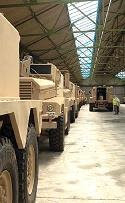
A total of 157 Ridgback armoured vehicles have been ordered from the US but only 20 have so far reached the frontline. The rest, along with a whole managerie of Panthers, Huskies, Coyotes, Bulldogs and Mastiffs, are waiting shipment at the MoD's Defence Storage and Distribution Agency's (DSDA) vehicle store in Ashchurch, in the badlands of deepest Gloucestershire.

Secrecy surrounding the armour on the new vehicles has been suggested as one reason why their deployment is held up; their "UK eyes only" classification means they have to wait for scarce transport from the RAF.

The MoD argues that it's a question of phasing of phasing: "It is imperative that if the mission is to be sustainable, we need to have a fleet in theatre and in the UK for training, maintenance and upgrades."

Whatever the reason, the soldiers on the frontline urgently need the added protection provided by these latest armoured vehicles.

So, MoD, get those doggies (and Ridgbacks) rollin' !

News of the World: ..trucks for our Boys...parked up by the M5
The Mail: 1,000 Army vehicles standing idle in a Gloucestershire warehouse
MoD: From car park to the frontline

The Independent: New armoured trucks 'for use in autumn'
The Times: Ridgback armour secrecy deprives British troops of vehicles

Friday, 31 July 2009

RAF's Eurofighter order slashed - Army's gain?


The government's decision to slash the final order for Urofighters/Typhoons may hopefully be good news for the guys on the frontline in Afghanistan.

The UK had originally agreed to buy 88 aircraft in the third and final tranche of the overall Urofighter order but that order has now been slashed to only 40 fighters. In total the RAF will now only be getting 160 Typhoons out of the 232 it had originally been promised.

It was only two months ago that Gordon Brown seemed to confirm that the UK was going ahead with the final order as planned: "I am pleased that we are moving forward with this important programme with our partner nations. This will strengthen Britain's defence capability, and will create new jobs in advanced manufacturing that Britain needs to emerge stronger and fitter from this global downturn." Still, we've come to expect U-turns from the government these days.

The Urofighter programme began in the mid-80s and originally aimed to provide an aircraft to dogfight Soviet jets over mainland Europe. Things have obviously moved on since the Cold War days and many strategists believe that the Urofighter is no longer appropriate for the type of conflict that Britain has to face.

Maybe the MoD could be persuaded to divert some of the RAF's leftover funds to provide practical support to British troops in Afghanistan.

The Times: Britain's fighter jet fleet of Eurofighter Typhoons cut by a third

Monday, 27 July 2009

Assault without battery: the self-powered soldier


Engineers at Leeds University are developing a way to capture the kinetic energy produced when soldiers march, convert it into electrical energy and use it to power their equipment (radios, night vision goggles, torches etc).

The devices or 'energy harvesters', would use high tech ceramics and crystals as piezoelectric transducers in order to convert mechanical stress into an electric charge.

Instead of the need for heavy batteries, new technology would plug directly into the soldier's clothing and gear thereby knock up to 10kg off what a soldier has to carry. Eliminating the need for batteries would also reduce resupply requirements.

In a company-sized patrol on a 48 hour operation the average battery weight per man is 3.76kg with a maximum of 10.5kg. With the total carried weight ranging from 33kg to 55kg, batteries account for 10% of in the average weight and 30% in the worse case (CDE Seminar Defence Research 2009).

The Leeds project links in with the MoD's Defence Research Programme 'Reducing the Burden on the Dismounted Soldier' which is aimed at finding new ways to reduce the weight that the modern soldier has to carry - body armour, communications and IT kit, lunch and other essential equipment.

In the States researchers have been looking at other ways of reducing the soldier's need to lug around batteries by generating and storing their own power. One solution is 'nanostructured fibre'. These fibres, woven into military uniforms, would act as rechargeable batteries or 'photovoltaics'.

Leeds University: Soldiers turn a march into a charge
Technology Review: Weaving Batteries into Clothes

MoD Defence Codex: Call for weighty ideas to lighten soldier’s load

Wednesday, 15 July 2009

Australian robot competition


The Australian government has announced a $1.6million competition to come up with the next generation of military robots.

The robots will be designed to carry out surveillance missions in urban combat zones thereby replacing soldiers in what are very dangerous situations. Although the robots will initially be unarmed, the Australian government intends that they will ultimately have the capability to neutralize enemy forces - i.e. "Exterminate them!"

The shortlisted entrants will demonstrate their prototype machines at the Land Warfare Conference in Brisbane in November next year.

TechRadar: Australian Govt launches killer robot competition